Do Pokémon Sleeves Fit MTG Cards?
By Dana Whitfield, MTG player since 1996 · Updated
Households that play both games ask this constantly, usually while staring at a half-empty pack of sleeves from the other game. The short answer is yes, and the sizing system behind that yes is worth two minutes, because it also answers every neighboring question about toploaders, binders, and deck boxes.
In this guide
The direct answer — one card standard, one sleeve ecosystem.
The exceptions — where cross-game sizing actually breaks.
Buying once for both games — the practical shopping list.
The Direct Answer
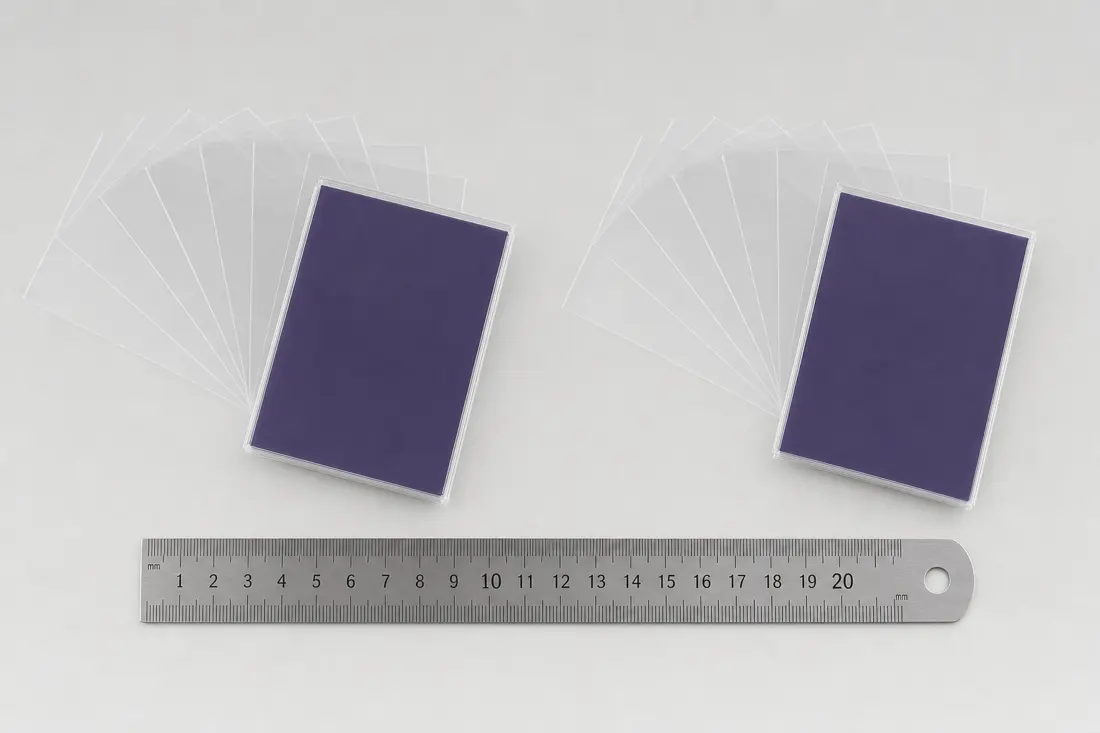
Sleeve packaging markets by game because branding sells, but the film inside the pack does not know which game it is protecting. A "Pokémon" penny sleeve and an "MTG" penny sleeve from the same production line are the same product. Our own penny sleeves are cut at 2.67 x 3.6 inches, the standard penny cut, and buyers on the source listing use them across games: one verified buyer wrote "Perfect for Pokemon cards. They are a bit thin, but for the price and everything else, I think it's fine." The listing they bought from is rated 4.6/5 across 1,716 buyer ratings with over 10,000 units sold.
The equivalence holds for rigid protection too. Our 3 x 4 inch toploaders accept any sleeved standard card, whichever logo is on the back. The full nesting system, from card to sleeve to holder, is laid out in the sleeve sizes guide.
Where Cross-Game Sizing Breaks
A Japanese-size sleeve on a Magic card simply does not close over the card, so that mistake announces itself in the first second. The reverse mistake, a standard sleeve on a Yu-Gi-Oh card, technically fits but leaves the card swimming, which defeats the snugness that protection depends on. If your household plays Yu-Gi-Oh alongside the big two, keep a separate small-format sleeve supply and label the boxes.
Oversized cards, promotional box toppers, and vintage oddities need case-by-case holders. And thick relic or memorabilia cards from sports sets need high-point toploaders, a sizing system explained in the points section of the sizes guide. None of these edge cases affect the everyday question this article answers: for the standard cards that make up essentially all of a Pokémon or Magic collection, protection is fully interchangeable.
Buying Once for Both Games
This is the practical payoff of the shared standard. A two-game household does not need two protection inventories. One bulk pack of 200 or 300 penny sleeves covers the Magic binder and the Pokémon binder alike at $14.99 to $19.99, and one combo of toploaders handles the valuable singles of both games. The only per-game purchase that makes sense is play sleeves with themed art, which is a preference, not a sizing requirement.
Deck boxes and carrying cases follow the same rule with one caveat: capacity counts assume a sleeve thickness. A box rated for 100 double-sleeved Commander cards swallows a 60-card Pokémon deck in penny sleeves with room left over, but the reverse can pinch, because thick play sleeves take noticeably more depth than penny film. When a shared household case must hold both games, size it against the thickest sleeving in use, not the average, and the lids will keep closing.
Binders deserve the same one-time check. Nine-pocket pages hold sleeved standard cards from either game interchangeably, and the practical habit is organizational rather than dimensional: keep each game's pages contiguous so a visiting trade partner can flip one section without touring the other game's collection. The protection layer neither knows nor cares.
One last cross-game note on toploaders, since mixed households ship cards too: the 3 x 4 inch rigid format holds a sleeved card from either game for mailing, and the packing method in our grading prep guide applies unchanged whether the card being shipped shows a Charizard or a shockland. One set of supplies, one method, every game in the house covered.
The question behind the question is usually about waste: nobody wants to buy a second protection inventory when the first is half full. The sizing standard means you never have to. Finish the pack you have, whichever game's name is on it, and restock with unbranded bulk when it runs out. Sleeves do not expire, extras never go to waste, and a shared drawer of standard-size protection serves every deck in the house without a single compatibility check.
Storage advice is likewise game-agnostic: the pressure, humidity, light, and friction that age a Magic card age a Pokémon card the same way, and the long-term storage guide applies to both shelves. Protection is one of the few places in the hobby where the boring generic answer is also the right one.