Why MTG Foils Curl (and How to Flatten Them Without Damage)
By Dana Whitfield, MTG player since 1996 · Updated
Every collector meets it eventually. A foil that lay flat in the binder in spring comes out in November bowed like a roof tile, and nothing touched it in between. Foil curling is not damage in the usual sense: nobody bent the card, nothing is torn or creased. It is the card reacting to the air in the room, and once you know what it reacts to, you can read the curl, reverse it slowly, and stop it coming back.
In this guide
Why foils curl — the two-layer construction and what humidity does to it.
How to flatten one — the slow method, and the shortcuts that ruin cards.
Keeping it flat — sleeve, toploader, box, and the tournament rule that makes it matter.
Why Foil Cards Curl and Regular Cards Do Not
A non-foil card is card stock through and through: it swells a little and evenly when the room turns damp, shrinks back the same way when it dries, and nothing inside it pulls in another direction. That is why it stays flat through the seasons that leave a foil bowed on the shelf.
A foil is a laminate: a printed metallised film bonded to a card-stock back. The Canadian Conservation Institute, the Government of Canada's conservation body, states the mechanism in its guidance on incorrect relative humidity: a change in humidity changes the moisture content of organic materials such as paper and glues, which in turn changes their size. Card stock is on that list; a metallised film holds its size. Bond the two and you have built a humidity gauge: when the room moves away from the conditions the card was made in, the back changes length, the face refuses, and the card bends to relieve the tension. The same guidance names the far end of that risk for flat sheets carrying an image layer: they may delaminate, fracture, or distort permanently. A curl is the mild, reversible end of the spectrum.
Arched or Cupped: What the Direction of the Curl Tells You
Lay the card face up. If the middle rises and the edges touch the table, the face is convex: players call this arching, and it means the back has lost moisture and pulled the card around the foil. If the edges lift and the middle sits down, the face is concave, the taco shape our storage guide describes: the back has taken on moisture and pushed outward.
Season is the usual culprit, not handling. Heated indoor air in winter dries the back and arches a binder that sat flat all summer; a damp summer or a basement cups the same cards. Humidity is one of the four enemies the storage guide lists, and for foils it is the one that acts within weeks rather than years.
| What you see | What the back has done | Direction of the fix |
|---|---|---|
| Face bulges out, edges down (arched) | Dried and shrunk | Add moisture, slowly |
| Edges lift, middle down (cupped) | Absorbed moisture and grown | Remove moisture, slowly |
| Curl comes and goes with the season | Room humidity is swinging | Stabilise the box, not the card |
| A sharp fold or crease line | Broken fibres, not humidity | Humidity will not reverse it |
The Humidity Numbers Archivists Actually Use
That guidance is written for family papers and photographs, and a Magic card is card stock with ink on it. Above 65 percent relative humidity the stated risk is mould and insect activity; below 15 percent, paper goes brittle. The placement advice reads as if a collector wrote it: out of damp basements, garages, and hot attics, on a shelf rather than the floor, away from pipes, windows, and known leaks.
Inside those walls, foils care about movement more than position. The Canadian Conservation Institute grades humidity control by how far it is allowed to swing, and its strictest class holds plus or minus 5 percent. A living room does not hold that, and each seasonal swing sends every foil in the house looking for a new shape. A closed box with a small buffer of silica gel, or a two-way humidity pack, rides out the swings the room cannot.
How to Flatten a Curled Foil Without Heat
For an arched card (too dry). Take a lidded plastic box, lay a paper towel in the bottom that has been dampened and wrung until it no longer drips, and raise the cards above it on something dry so card and towel never touch. Cards go in unsleeved, face up so the arch points at the lid. Check every few hours: the card takes moisture back through its paper side and will pass through flat on its way to cupped, so the job is to catch it at flat. Condensation on the lid means the towel is too wet.
For a cupped card (too damp). Same box, no towel, a few silica gel packets in the bottom and the cards raised above them. Drying is gentler than humidifying and usually takes longer, so check less often and expect days. Again, out at flat, not after.
Then hold the shape. A card just coaxed flat is not yet stable; its moisture is still evening out through the paper. Slide it into a penny sleeve, lay it between two flat surfaces, a closed book is the classic, and leave it overnight in the room it will live in. The sleeve keeps the surfaces off the foil; the light, even pressure keeps the card from taking a new set while it settles.
Two limits, because this is a practice collectors have converged on rather than a laboratory procedure. It reverses curl and only curl: a crease or a bent corner has broken fibres, and no humidity un-breaks them. And a card flattened this way curls again the moment it returns to the air that curled it, which is why the box is the other half of the job.
The Shortcuts That Turn a Curl Into Damage
Heat. The temptation is obvious: warm the card, press it flat, let it cool. Warming a glue-bonded laminate is also the standard way to take one apart, and the two layers of a foil expand at different rates as they warm. The failure mode is the one the conservation guidance names, delamination, and a face that has lifted at a corner does not go back down. The method above never needs heat.
Force. Curving a foil back against its arch by hand feels like it works, because for a minute it does. The paper springs back to whatever the air is doing; the metallised face, which has no spring in it, keeps a faint line where it was flexed hardest. Under a judge's lamp that line reads as a mark.
Water and weight. Water is the mistake hiding inside the good method: a towel that drips, a card that touches it, a lid that rains condensation back down. Wring harder, raise the cards higher. Weight on its own, books with no humidity correction underneath, presses a curved card flat for as long as the books stay on and no longer; pressure holds a shape without changing what the paper wants to do.
Keeping a Flat Foil Flat: Sleeve, Toploader, Box
The sleeve slows the exchange. Humidity reaches a card through its paper, exposed on the back and along four edges. A soft sleeve puts a film between card and room, so a change in the air reaches the paper later and more gently. Double sleeving closes the openings in opposite directions, which is why a double-sleeved foil reacts far more slowly to a season, and why every foil we intend to keep goes in two sleeves.
The toploader holds the line. A sleeve is film, and film follows the card. A toploader does not: its 3 x 4 inch shell with 0.07 inch walls is the rigid layer in this system, and a freshly flattened, sleeved card goes into one and stays the shape the toploader is. It is the same reason toploaders are the shipping standard in our grading prep guide: the holder takes the bending force so the card does not.
The box sets the air. Keep foils in a closed container rather than an open binder, with a small buffer inside: silica gel if your rooms run damp, a two-way humidity pack if they swing with the seasons, replaced or recharged on a schedule. Then put the box where the storage guide puts it, off the floor and out of the basement and the attic, and where the National Archives adds: away from pipes, windows, and known leaks.
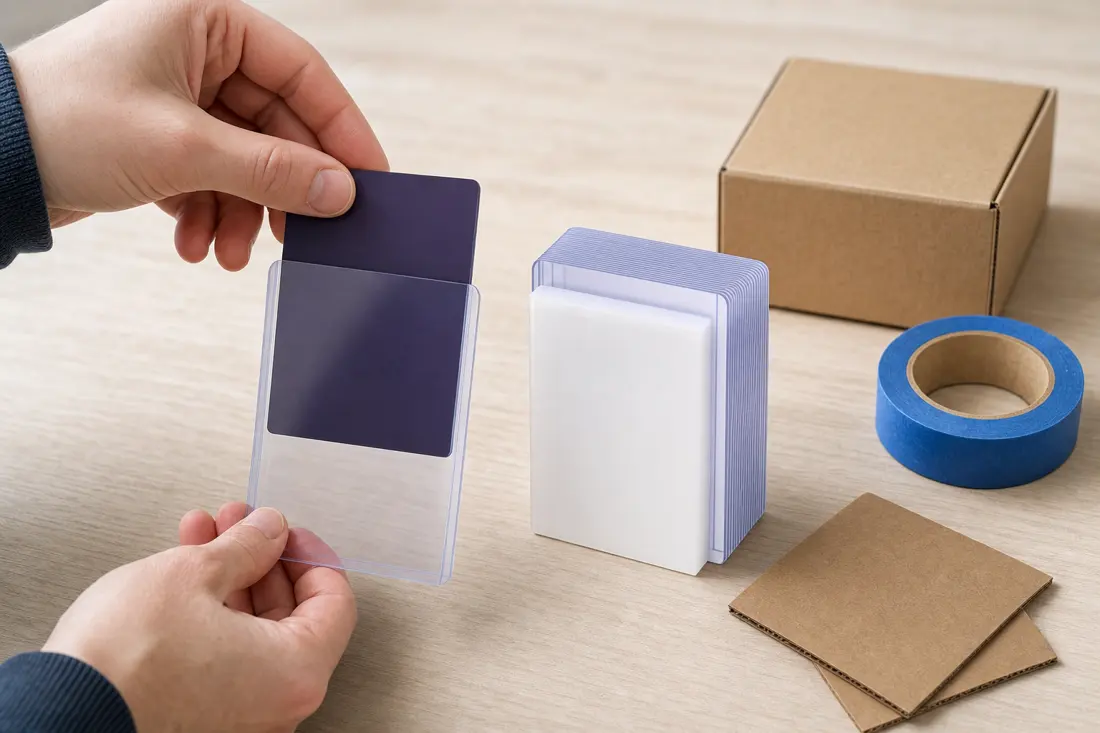
The combo is why we bundle rather than sell the two apart: every SleeveGuard toploader combo ships with 100 penny sleeves, from $24.95, and the bulk packs run 100 to 300 sleeves at $9.95 to $19.95, about a dollar per protected card or less. Fresh sleeves matter for the reason the sleeve wear guide gives: a flared mouth lets the room straight back in.
Why a Curled Foil Is a Tournament Problem
The rule does not mention foils, and it does not need to. A judge squares up a deck and looks along its edge; a card that stands proud of the block, or a group that all curl the same way, is identifiable without its face being seen. The same section states that sleeved cards are examined while still in their sleeves, so a curl has to be fixed in the card, not hidden by the sleeve. Our guide to custom sleeves and the tournament rules covers what a deck check looks for.
The routine is the one judges use. Square the deck, hold it edge-on to a lamp, and look for anything proud of the block. A foil that has started to arch needs the box treatment above, and that takes days, so the check belongs a week out rather than the night before. Cards that live between events in a sleeve, a toploader, and a buffered box start flat, and none of the method involves heat.